Octavius Black CBE on what makes work good — and why it matters for society
At the Jobs Foundation’s February Business Council breakfast, held last week at Old Queen Street Cafe in Westminster, Octavius Black CBE, founder of Mind Gym and Executive Chair of the Jobs Foundation’s Employer Taskforce, shared findings from Mind Gym’s latest report on well-working and what the science of behavioural psychology tells us about what makes […]
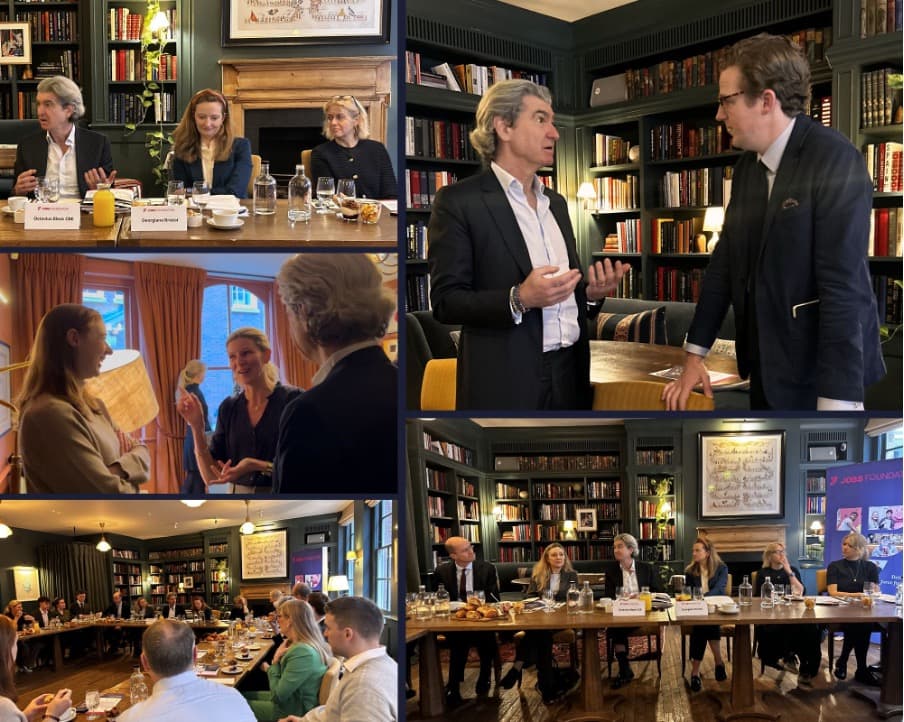
At the Jobs Foundation’s February Business Council breakfast, held last week at Old Queen Street Cafe in Westminster, Octavius Black CBE, founder of Mind Gym and Executive Chair of the Jobs Foundation’s Employer Taskforce, shared findings from Mind Gym’s latest report on well-working and what the science of behavioural psychology tells us about what makes a job truly good.
Introduced by Jobs Foundation CEO Georgiana Bristol, Octavius opened with a striking finding from research conducted across multiple professions: when asked whether they viewed their work as a job, a career or a calling, doctors and hospital janitors gave almost identical answers, roughly a third each. The implication, he argued, is profound. What makes work meaningful is rarely the work itself, or the pay. It is far more about how the individual thinks about their work, and the environment, the boss, the team, the culture, that shapes that thinking.
He went on to set out five conditions that the research identifies as essential to healthy, meaningful work: a degree of certainty, so that people know what to expect from those around them; self-efficacy, the belief that the task at hand is within reach; autonomy, illustrated by the consistently better work-life balance reported by the self-employed across multiple cultures; belonging, the sense of being with people one respects and trusts; and purpose, not the corporate mission statement kind, but the more personal conviction that if I hadn’t done that work, someone’s situation would be worse.
Octavius also challenged the £60 billion spent annually on corporate wellbeing programmes globally, pointing to longitudinal research showing that yoga, gym memberships and similar initiatives produce no statistically significant improvement in employee health and wellbeing on 78 out of 80 measures. The real levers, he argued, lie elsewhere.
A particularly useful framework he introduced distinguished between ill-being and wellbeing as separate axes, not opposites. Someone can be exhausted and worn out, high on ill-being, while still feeling purpose and belonging. Others, whom he described as “fragile deliverers,” perform brilliantly until they suddenly don’t, because they are running on empty beneath the surface. And a third group, “boring out,” are neither distressed nor engaged. They simply need purpose and connection, not more certainty or resources. Understanding which group an employee is in, he suggested, should determine the response.
The discussion also touched on the return-to-office debate, with audience members including the CEO of a 40-person business raising questions about remote working and belonging. Octavius was clear that the social and cultural fabric of a workplace cannot be built on a screen, and that younger employees in particular benefit enormously from proximity to colleagues. He pushed back on the phrase “work-life balance” altogether, arguing that the framing treats work as the opposite of life rather than a central part of it.
On AI, Octavius noted that while appetite to use tools like ChatGPT is high, organisations, particularly larger ones, are slower to think structurally about how AI changes the nature of work itself. He described the key differentiator as “AI agility”: the speed at which an organisation can learn, adapt and act, and the degree of freedom it gives people to experiment and find better ways of doing things.
Georgiana Bristol closed the formal session by reflecting on the Jobs Foundation’s Employer Taskforce, which Octavius chairs. With over 9 million people economically inactive in the UK, she underlined that getting people into good work requires a collective effort across the entire business community, and that the forthcoming Jobs Foundation Pledge, due to launch in the autumn, is designed to make best practice accessible, especially for the SMEs that are so often the country’s biggest employment generators.