Our CEO’s Speech at the Better Hiring Institute
Our CEO speaks at the House of Commons on employment best practice.
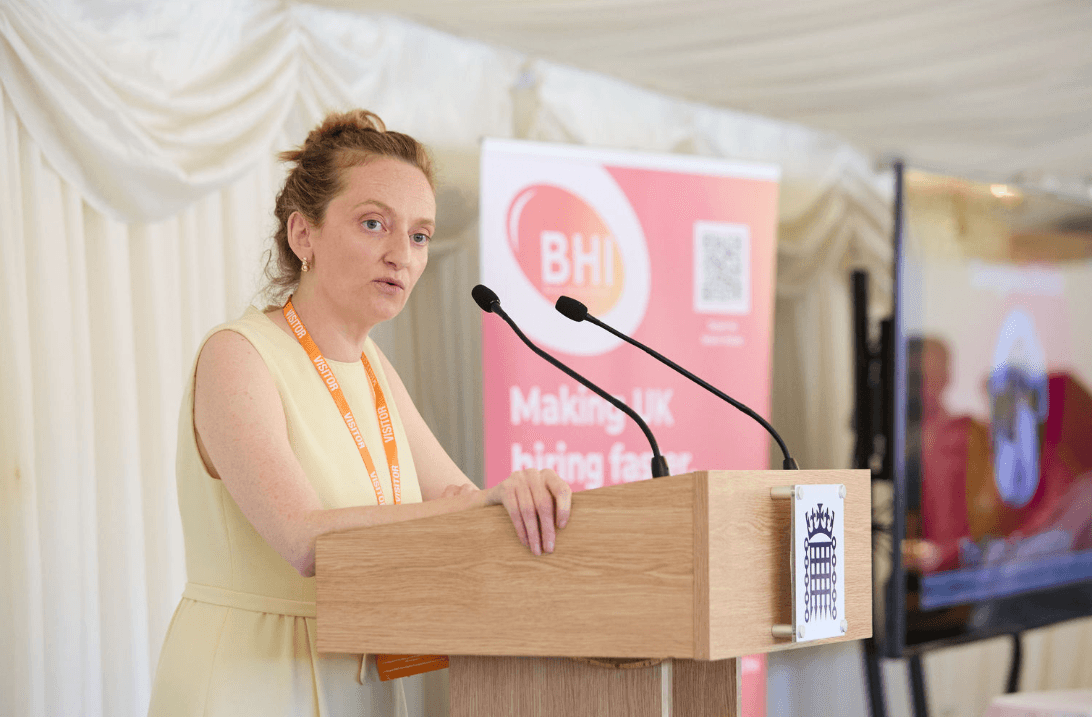
Last week, the Better Hiring Institute brought together hiring leaders and Parliamentarians at the Terrace Pavilion on the River Thames to officially launch the Better Hirer Scheme – a new initiative designed to set clear standards and accountability for fairer, faster, and safer hiring across the UK. Our CEO, Georgiana Bristol, spoke at the launch, highlighting the power of jobs to change people’s lives. You can read her speech here:
Three years ago, my co-founder Matthew Elliott and I sat down with a straightforward but ambitious idea. We wanted to build something that could genuinely help people move from worklessness into meaningful, long-term employment. From that conversation, the Jobs Foundation was born, a charity dedicated to creating and supporting pathways into work, and to raising the ladder of opportunity so that people from every background have a real chance at social mobility.
Today, I want to talk to you about hiring. Not just as a business process, but as something far more profound. Because jobs are the door to opportunity, and hiring is the key. That is why I was excited to be invited to speak here today by the Better Hiring Institute, thank you all.
At the heart of everything we do at the Jobs Foundation is a belief that business is a force for good. When an entrepreneur takes the risk to set up or grow a business, they are betting on themselves. And if they succeed, the rewards are theirs. But the impact stretches far beyond them. They create growth. They create prosperity. And most importantly, for all of us in this room, they create jobs.
Jobs are not just an economic statistic. They are the foundation of dignity, of purpose, of self-worth. A job gives a person optimism. It gives them the means to provide for their family, to contribute to their community, to feel that they matter. Every single one of us deserves that.
Over the past three years, the Jobs Foundation has built a Business Council of nearly 1,500 businesses right across the United Kingdom. From care homes in Scotland to a bus manufacture in Northern Ireland. From high street brands like Marks and Spencer to global multinationals like BP. And to every single one of those businesses, hiring is fundamental. It is how they grow, how they serve their customers, and how they shape the communities around them.
Through our research and policy work, we have looked closely at the groups of people who face the greatest barriers to entering work. Last year, in our report Ladders of Opportunity, we examined five of them.
First, people living in areas where jobs are scarce, communities that have been left behind by economic change.
Second, people with long-term health conditions, who too often find the hiring process working against them rather than for them.
Third, young people. Nearly one million young people in this country are currently not in education, employment or training. Let that number sink in for a moment. One million. This is not just an employment issue; it is a social emergency.
Fourth, what we call unique groups: veterans, people who have experienced homelessness, and ex-offenders. Each of these groups faces its own specific challenges, and each requires its own tailored support.
And fifth, older workers, those between 45 and 60. I know that doesn’t sound old. But this group can easily find themselves frozen out of the hiring process, shut out of the workplace while they still want and need to work.
To research this report, we travelled the length and breadth of the United Kingdom. We spoke to businesses in Newcastle and Rotherham, in Gillingham and Exeter, in Wales and Northern Ireland. We spoke to charities and third sector organisations doing extraordinary work to bridge the gap between worklessness and employment.
And we spoke to people. Real people, with real stories.
We spoke to young people who had grown up in generationally jobless homes, in communities where work was not a given, where ambition had been quietly eroded over decades of neglect. And we heard from businesses like Amazon and IKEA, working with Barnardo’s on the Jobs Project, giving those young people a genuine chance to aspire to more.
I remember talking to a young man in Newcastle. He was on Universal Credit. He desperately wanted to work, not just for himself, but for his young daughter. He told us he couldn’t bear the idea of her growing up and asking him why he never had a job. He wanted to be her example. A few months later, we went back to Newcastle, and we heard from Angela at Barnardo’s that he’d found employment. He was thriving. He was aspiring to more.
That story tells us everything we need to know about why hiring can never simply be about finding the easiest candidate. It must be about giving those with the character and the drive, even when they’re not the obvious choice on paper, a genuine chance to prove themselves.
We also met a man in his fifties in London. He had been out of work for a couple of years, sending application after application, and hearing nothing back. He was being supported by the Shaw Trust, a wonderful charity providing employability support to people of all ages. Will told us how demoralising it was. He just couldn’t get in the front door, rejected because of his age, or because he was told he was overqualified.
His story reminds us that career paths are not always straight lines upward. They swerve. They stall. They double back. They stop and restart. A good hiring process needs to understand that, and to look beyond the neat, linear CV to the person behind it.
From all of this research, we began to distil the principles of best practice in hiring, training, and retaining workers. And we believed that more could be done by bringing large and small businesses together to learn from one another.
That was how the Jobs Foundation Employer Taskforce was born.
Over this past year, we have brought together businesses including Pret, BP, Barclays, and Greene King, working collaboratively to build something genuinely meaningful. The result is the Jobs Foundation Pledge, an accreditation scheme designed to recognise the great work that businesses are already doing to bring people from worklessness into employment, and to give those just beginning their journey a roadmap based on what works.
The Pledge is built on four pillars: Outreach, Recruitment, Training, and Career. Together, they represent the full arc of a person’s employment journey, from being found, to being hired, to being developed, to being given a future.
We are publishing a report on the growing crisis of young people not learning or earning, the so-called NEETs. And what we are finding is deeply concerning. It is not simply a rise in youth unemployment. It is a rise in economic inactivity among 16 to 24 year olds, driven in significant part by a surge in young people experiencing mental health difficulties.
Research consistently shows that secure, supportive employment is one of the most powerful contributors to wellbeing. Work gives people structure, purpose, community, and confidence. So when we see young people locked out of the labour market, not just unemployed, but disengaged from it entirely, we have to ask a hard question.
Is the hiring process part of the problem?
We have seen businesses and charities and schools experimenting with more flexible approaches, processes that prioritise character over grades, potential over polish. And these approaches are working. They are reaching young people who had come to believe the labour market had no place for them.
All people deserve the dignity of a job. Young or old. Veteran or ex-offender. Someone who has experienced homelessness or someone who grew up in a deprived community. Every single person deserves the purpose, the self-esteem, and the optimism that comes from meaningful work.
Making hiring straightforward and faster — a core purpose of the Better Hiring Institute’s work — allows businesses to be more dynamic. It drives growth. It creates opportunity. And right now, we have a chance to get this right. Building the right structures and removing barriers around hiring must be the priority. Because when those structures are missing, the people who pay the highest price are those who already have the most to overcome.
Why would a business take a risk on a young person with no experience, not yet work-ready, when the cost and complexity of that hire has been made even greater? Why would an employer open a door to someone who needs a little more support, a little more patience, a little more investment, when the system makes it harder, not easier, to do so?
The businesses in this room, the businesses on our Council, the businesses on our Taskforce, they are going above and beyond because they believe in doing the right thing. But good intentions can only go so far when the policy environment is working against them.
We need government to be a partner in this mission.
Let me close with this.
When a business hires someone who others passed over, someone who grew up without opportunity, someone who has known hardship, someone who just needed a chance, they don’t just change that person’s life. They change their family’s life. They change their community.
They make it possible for a young man in Newcastle to be proud to come home from work to his daughter. For Will to hold his head up high because his employer values his work.
That is what the Jobs Foundation is here to do. And that is what all of you, by being here, by being part of this conversation, are here to do too.
Hiring is the key. Let’s make sure we use it.