Our June Business Council Breakfast with our President, Lord Elliott
Our President on his upcoming memoir – and campaigning, business and the battle of ideas
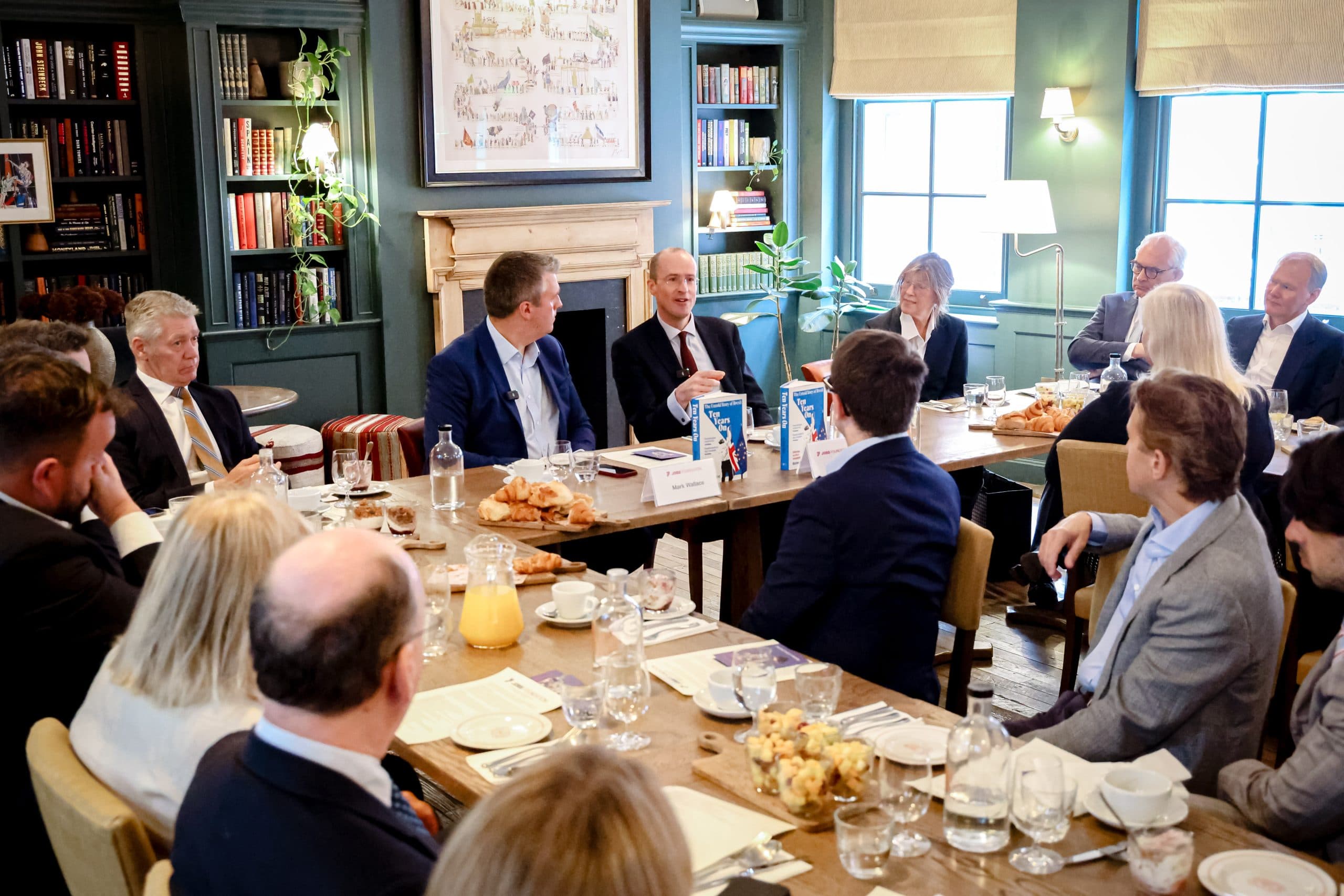
Last week, we had the pleasure of hearing from our President and co-founder, Lord Elliott of Mickle Fell, as the guest speaker for our June Business Council Breakfast. Ahead of the publication of his latest memoir, Ten Years On: The untold story of Brexit – reflections on a life campaigning, Matthew was interviewed by Total Politics CEO, Mark Wallace. As well as the book, the conversation drew on Matthew’s career in policy and campaigning to explore questions central to what the Jobs Foundation does: how do you shift the economic debate, and what does it take to make the case for business as a force for good?
Matthew’s answer, developed across the conversation, was that campaign groups matter much more than they are sometimes given credit for. He gave the example of how when he co-founded the TaxPayers’ Alliance in the early 2000s, there was no serious voice making the case that government waste was the enemy of growth and opportunity. Filling that gap, he argued, was more valuable than a seat in Parliament. Campaign groups can set the terms of debate, build coalitions and hold a position through political weather that no party could survive. The most enduring progress on economic policy, in his view, comes from independent organisations willing to make the argument before it is fashionable.
Matthew talked about how this approach inspired the launch of the Jobs Foundation. Business creates jobs, and opportunity, but the pro-business case does not make itself, and the political environment in which business operates is shaped by voices that are often indifferent or hostile to it. Independent organisations that champion the conditions businesses need to hire and grow – lower costs, stable policy, a tax environment that rewards enterprise – perform a function that no trade body or political party can fully replicate.
Matthew drew on his experience as a parliamentarian to make the point explicitly. He recalled the recent story of Rishi Sunak as Chancellor describing the pressure he faced to raise the minimum wage beyond what he believed the economy could sustain. When that Chancellor called round business groups and asked them to make the case publicly that the rate had gone too far, none would. The result was that a policy with real consequences for hiring – especially for young people on the margins of the labour market – went unchallenged. Independent organisations, Matthew argued, exist precisely to provide that cover, and politicians who have sat on both sides of the divide understand their value in a way that those who have only ever worked inside the system often do not.
On the fragmentation of British politics, he argued that the financial crisis broke the assumption that living standards would keep rising. The old alignments between class, income and party have dissolved, and the result is a more volatile political environment in which ideas can travel faster but in less predictable directions. For organisations making the pro-business case, that creates both risk and opportunity. More parties competing for votes means more openings to place ideas about jobs, investment and enterprise, but also more routes by which damaging ones can gain traction.
His prescription was to get out early with the argument, show public and media support, and build the broadest possible coalition of pro-business voices. That coalition, crucially, must reach beyond the usual suspects. The strongest campaigns on economic policy, he argued, are those that can bring together business, trade unions, civic society and the media around a shared interest in growth and opportunity.
It was a privilege to have Matthew with us. His career is a reminder that the battle of ideas has to be fought continuously by those who believe that business, given the right conditions, is the most powerful tool we have for creating jobs, reducing poverty and building opportunity. That belief is the foundation of everything the Jobs Foundation does, and it was energising to hear it articulated with such passion and insight.
You can buy Matthew’s book here.